# How to Start an EV Charger Installation Business in the UK
The UK's Zero Emission Vehicle mandate requires 80% of new car sales to be zero-emission by 2030, and almost every new EV driver with a driveway wants a home charger. Fitting it is the skill. Qualifications, notification rules and pricing upgrades properly decide whether the business makes money.
This guide covers qualifications, the rules, what it costs to start, real prices, and how many installs you need to break even.
1. Qualifications
You need to be a competent electrician working to BS 7671 (18th Edition), which Trade2Base names as the minimum. Add a dedicated EV charge point installation course, and get approved by the charger brands you'll fit.
2. Register the business
Register for Self Assessment or set up a limited company. Join a competent person scheme such as NICEIC or NAPIT, so you can self-certify notifiable work.
3. Part P and the network
- A charger usually needs a new circuit, which is notifiable under Part P in England (Planning Portal).
- Tell the network operator as required. A 22kW unit needs three-phase power and a full G99 application before connection (Trade2Base).
- A supply upgrade can cost the customer £1,000 to £5,000+, and commercial connections £5,000 to £50,000+.
4. What it costs to start
Our free calculator's planning figures:
| Item | Lean | Base | High |
|---|---|---|---|
| 18th Edition and EV charger courses | £0 | £1,000 | £2,000 |
| Competent person scheme registration | £0 | £600 | £900 |
| Insurance (year 1) | £100 | £500 | £1,200 |
| Van (used purchase or deposit) | £0 | £8,400 | £15,000 |
| Test equipment and tools | £300 | £1,500 | £3,000 |
| Starter stock | £200 | £600 | £1,500 |
| Manufacturer approvals and demo charger | £0 | £300 | £800 |
| Website, signage and marketing | £200 | £1,000 | £3,000 |
| Working capital reserve | £1,000 | £3,000 | £6,000 |
| Total | £1,800 | £16,900 | £33,400 |
Work through your own figures with the free EV charger installer startup calculator.
5. Smart chargers and grants
- Home chargers sold in Great Britain must be smart, with off-peak default charging hours, a randomised delay and security features (GOV.UK).
- Renters and flat owners with off-street parking can claim up to £350.
- Businesses can claim up to £350 per socket, for up to 40 sockets.
- Scotland offers up to £300 for eligible homeowners.
6. Insurance
Get public liability before your first job. MoneySuperMarket's August–October 2026 data put the average at £78.27 a year for up to £2m. Add professional indemnity and employers' liability when you take on staff.
7. Price your work
Trade2Base's 2026 guides give:
| Job | Price |
|---|---|
| Standard 7kW smart home charger, installed | £600 to £900 |
| Twin or higher-spec home unit | £1,000 to £1,200 |
| Workplace Type 2 charge point | £1,500 to £2,500 per point |
| Multi-point projects | £3,000 to £5,000 per point |
| Consumer unit upgrade | £400 to £900 |
| Pre-installation survey | £60 to £80, credited if booked |
Its example domestic quote is £280 for the charger, £240 labour for about 4 hours and £80 for commissioning and certification, plus VAT.
8. Work out your break-even
Our calculator's base example averages £900 an install with £420 of charger and materials, against £500 of monthly fixed costs and a £2,000 owner-pay target. That needs about 6 installs a month, roughly 2 a week.
9. Win the work
- Car dealers and lease companies referring new EV drivers
- Landlords, flats and workplaces using grants
- Google reviews and local search
- Solar and battery customers adding a charger
10. Run it like a business
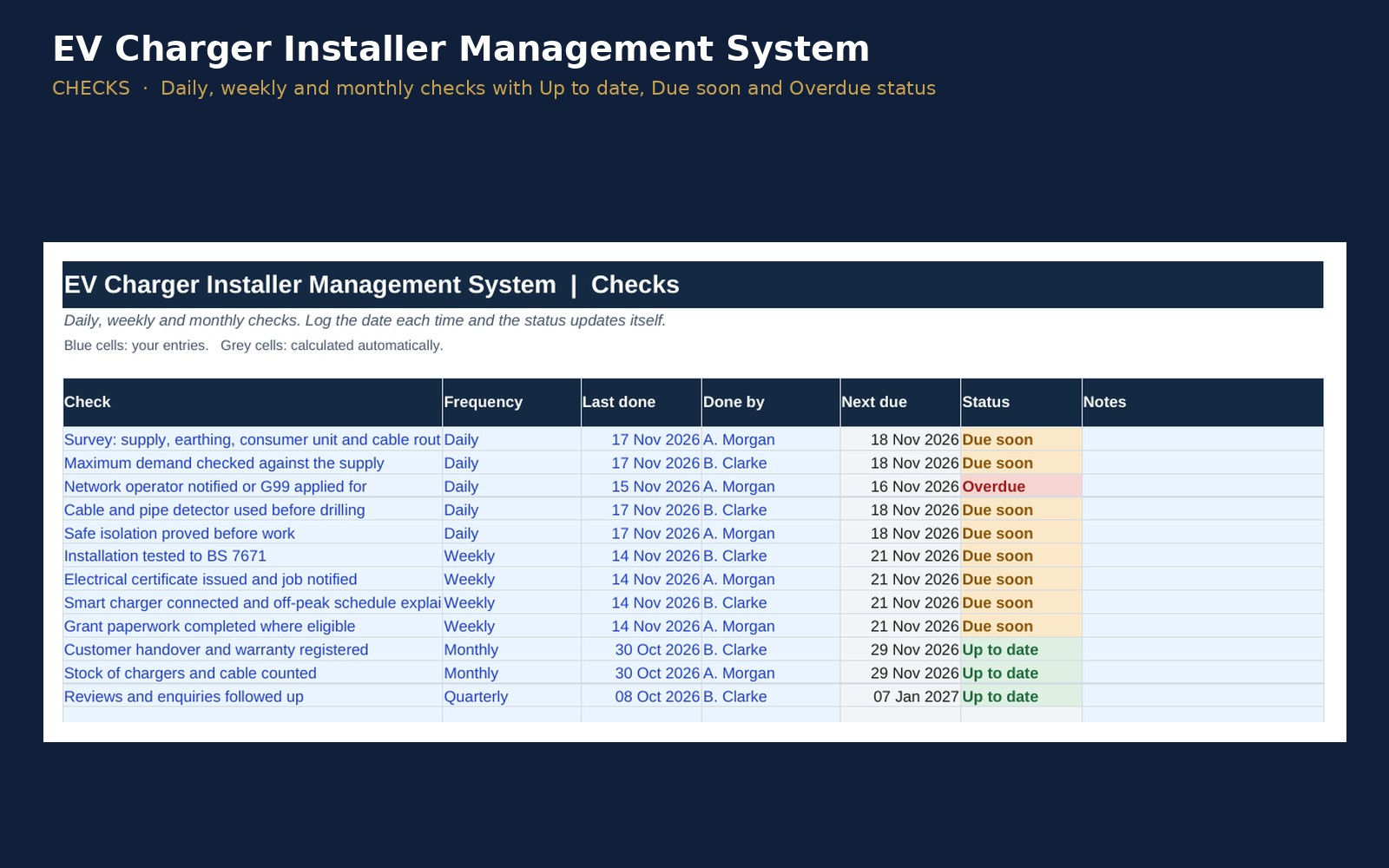
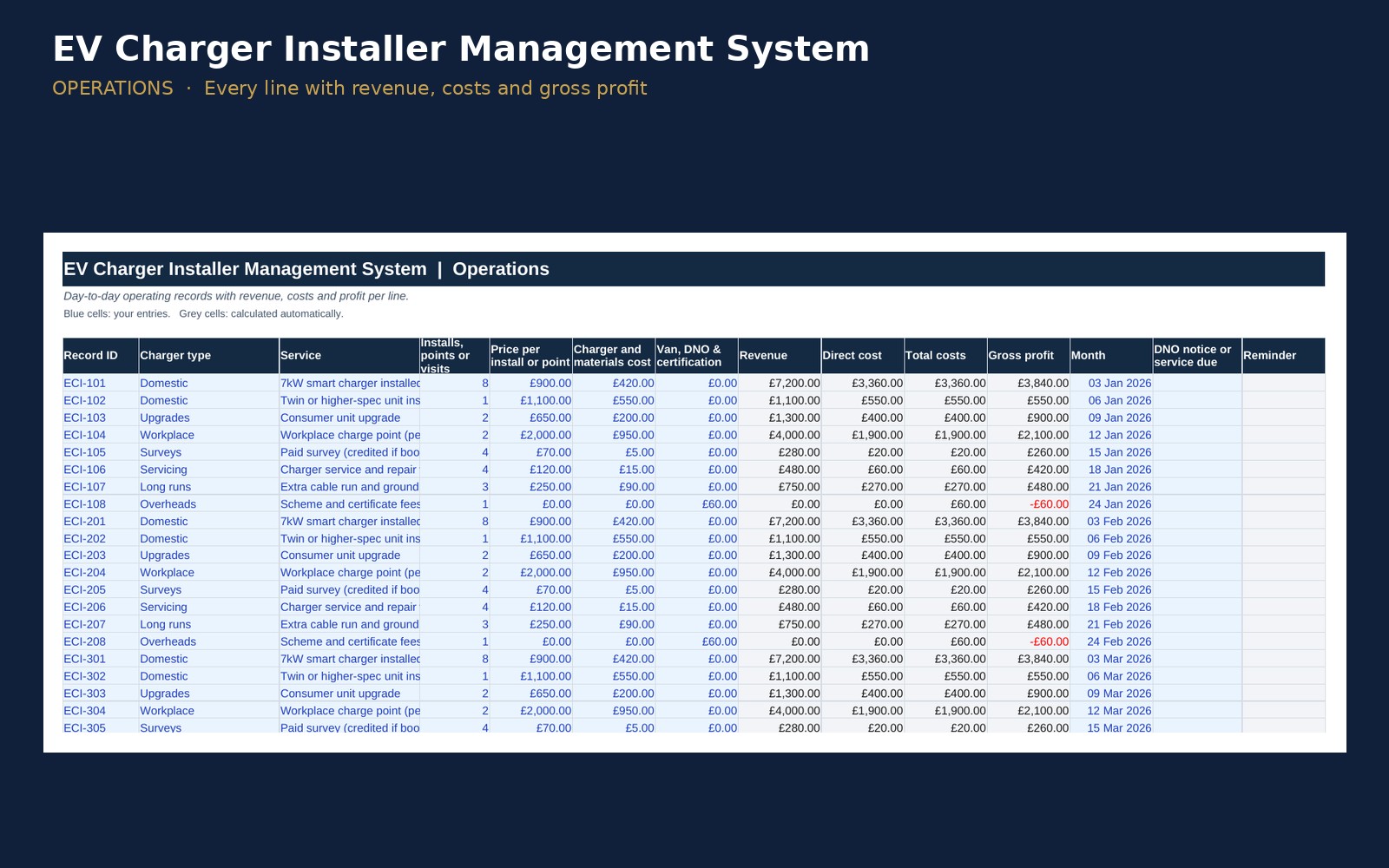
Track installs, average value, margin, survey conversion and callbacks every month. Keep certificates, notifications, grant claims and insurance in one place.
Your EV charger installation business start-up checklist
- [ ] 18th Edition
- [ ] EV charger course
- [ ] Competent person scheme
- [ ] Business set up
- [ ] Manufacturer approvals
- [ ] Public liability insurance
- [ ] Test equipment
- [ ] DNO process
- [ ] Break-even installs known
- [ ] Survey and install prices
Run it properly from day one
The **EV Charger Installer Management System** is an EV charger installation business spreadsheet that tracks every order, cost, invoice and VAT return, with checks, compliance dates, risks and stock in one Excel file. It costs £15 once, with no subscription. Planning to borrow? The EV Charger Installer Business Plan Template (£10) is laid out the way lenders expect, or get both with every free guide in the Full Business Pack for £20.
Next, read how much an EV charger installer earns and the KPIs to track.
Related: Electrician business startup costs
Related: Solar and heat pump installer startup costs
Frequently asked questions
How much does it cost to start an EV charger installation business? If you're already a qualified electrician with a vehicle and test kit, about £1,800 in our calculator. A base setup with training, scheme registration, a used van and full kit is around £16,900.
What qualifications do I need to install EV chargers? You need to be a competent electrician working to BS 7671 (18th Edition), plus a dedicated EV charge point course and manufacturer approvals.
How much does EV charger installation cost? Trade2Base's May 2026 guide puts a standard 7kW smart home charger at £600 to £900 installed.
Is there a grant for EV chargers? Renters and flat owners with off-street parking can claim up to £350, and businesses up to £350 per socket for up to 40 sockets.
Does an EV charger need Part P notification? Usually, yes. A charger normally needs a new circuit, which is notifiable under Part P in England.