Search "how to start an AI automation agency" and you'll mostly find American guides written in dollars, many of them selling a course. They skip the parts that decide whether a UK agency survives: data protection law, contracts, pricing in pounds, and the gap between building one automation and running a business.
This guide covers those parts, with numbers from our free UK AI workflow automation calculator.
1. What an AI automation agency actually sells
An AI automation agency builds and maintains workflows that remove repetitive work for other businesses: handling leads, answering routine customer questions, processing documents, producing reports, booking appointments and moving data between systems. You connect tools such as automation platforms and AI models. You are not writing software from scratch.
Clients don't buy "AI". They buy an outcome they can measure: hours saved, faster responses, fewer errors. Sell the outcome, and price against it.
2. Pick one niche and one problem
New agencies often fail because they offer "AI for everyone". Pick an industry you understand (accountants, letting agents, dental practices, gyms, trades) and one painful, repeatable process within it. Every build in the same niche is faster than the last, because you reuse workflows, prompts and documentation.
3. Get UK data protection right from day one
This is what separates a UK business from a hobby. Almost every automation touches personal data: names, emails, phone numbers, enquiries, invoices. Under UK GDPR, your client is usually the controller and you are their processor. That means:
- A written data processing agreement with every client before you touch their data. It sets out what you process, why, how it's secured, and what happens at the end of the project.
- An ICO data protection fee. Most businesses that process personal data must pay one each year. Micro businesses pay the lowest tier.
- Minimised test data. Build and test with dummy or minimised data, not live customer records.
- AI provider settings. Check whether the AI tools you use store or train on submitted data, and set retention options accordingly.
- Access control. Store API keys securely, give yourself least-privilege access, and remove your access when a project ends.
The 2026 automated decision-making changes
The Data (Use and Access) Act 2025 changed the rules for automated decisions. From 5 February 2026, organisations can rely on any lawful basis, including legitimate interests, for automated decision-making, as long as appropriate safeguards are in place. The ICO confirmed on 19 June 2026 that all the Act's data protection provisions are now in force.
That opens up more automation work, but two limits matter for your builds: - Safeguards are still required: people must be told about significant automated decisions, be able to challenge them, and be able to get a human to review them. - The previous prohibition remains on using special category data (such as health, race or biometric data) in solely automated significant decision-making.
So a lead-scoring or triage workflow that makes significant decisions about people needs a human review step, and anything touching health data (a dental practice or a clinic, for example) needs extra care.
4. What it costs to start
Our free calculator puts a UK start at £600 to £2,500 for a minimal setup and £2,000 to £6,000 fully equipped:
| Item | Typical cost |
|---|---|
| Business registration | £0 (sole trader); limited company: £100 digital or £124 paper filing |
| AI and automation subscriptions | £100 to £600 a year |
| Professional indemnity insurance | £150 to £400 a year |
| Website and portfolio | £0 to £1,000 |
| Courses and certification | £200 to £2,000 |
| Marketing and content | £0 to £500 |
| Accounting software | £180 to £360 a year |
The real cost is time: learning the tools, building your first case study, and the unbilled hours spent on sales and scoping.
5. Work out your minimum day rate
Most new consultants price by looking at competitors. Start from what you need instead. In the calculator's worked example:
- £3,000 a month take-home target = £36,000 a year
- Gross it up for roughly 25% tax and NI: £48,000
- Add £3,000 of annual business costs: £51,000 required revenue
- 115 billable days a year (realistic once sales, admin and learning are counted)
£51,000 ÷ 115 days = a minimum viable day rate of about £443. Below that, you are paying to work.
Retainers change the picture. With 4 retainer clients, the same £51,000 needs a minimum retainer of about £1,063 a month per client. Recurring income is what makes an agency stable.
6. Price in packages, not hours
UK 2026 market ranges built into the calculator:
| Service | Typical UK price |
|---|---|
| Discovery or automation audit | £500 to £2,000 per project |
| Implementation project | £2,000 to £15,000 |
| Monthly support retainer | £500 to £2,500 a month |
| Training workshop | £500 to £2,000 a day |
Three rules protect your margin: 1. Fixed-price packages with a written scope and acceptance criteria. Price changes separately. 2. Turn every build into a retainer for monitoring, fixes and improvements. Workflows break when the tools they connect to change. 3. Pass software and API costs through with a clear margin, and include a clause allowing for platform price rises.
Expect pressure on simple builds. Industry estimates suggest automation pricing fell about 35% between 2024 and 2026 as tools matured. Your edge is niche knowledge, reliability and compliance, not the build itself.
7. Contracts and insurance
- Terms of business: scope, change requests, payment stages, what happens if a client's tools change, and limits on liability.
- Intellectual property: who owns the workflows, prompts and documentation, and whether you can reuse generic components.
- Professional indemnity insurance: an automation that emails the wrong people or misroutes invoices can cause a client real loss.
- Cyber insurance: you hold access to client systems and data.
- Cyber Essentials: the government-backed certification is a credible trust signal for clients nervous about security.
8. Find your first clients
Start with businesses you already know in your chosen niche. Offer a paid audit that maps their processes, estimates hours saved, and recommends the first build. The audit pays for your time and leads naturally into the implementation project and then the retainer. Every finished project should produce a short case study with before-and-after numbers.
9. Choose tools you can support
Pick one automation platform and one AI model family to master before adding more. Clients pay for reliability, and every extra tool is something else that can change, break or raise its prices. When choosing tools for a client build, check:
- Where data is processed and stored, and whether the provider offers settings that stop your client's data being used for training.
- Pricing per run or per task, and how it scales as the client's volume grows. A workflow that's cheap at 100 runs a month can be expensive at 10,000.
- Error handling and logging, so you can see when something fails and why.
- Export options, so a client isn't locked in if they leave you, and so you can back up your work.
Document every build: what it does, which accounts it uses, where credentials are stored, and how to switch it off. Good documentation is part of what the retainer pays for, and it protects you if a client's staff change.
10. Common mistakes new agencies make
1. Selling AI instead of an outcome. "We'll add AI to your business" doesn't sell. "We'll cut your enquiry response time from a day to five minutes" does. 2. Building before scoping. A free "quick build" becomes a project that never ends. Charge for the audit. 3. No data processing agreement. It's a legal requirement when you process personal data for a client, and clients increasingly ask for it. 4. Testing on live customer data. Use dummy or minimised data until a workflow is approved. 5. Absorbing software costs. API and platform usage grows with the client. Pass it through. 6. No monitoring. Automations fail silently when a connected tool changes. Monitoring is what keeps a retainer valuable. 7. Ignoring tax and status. Register for Self Assessment or set up a limited company, keep records from day one, and watch the VAT threshold. If you work through your own limited company for medium or large clients, the off-payroll working rules (IR35) may apply to some engagements.
11. Run it like a business
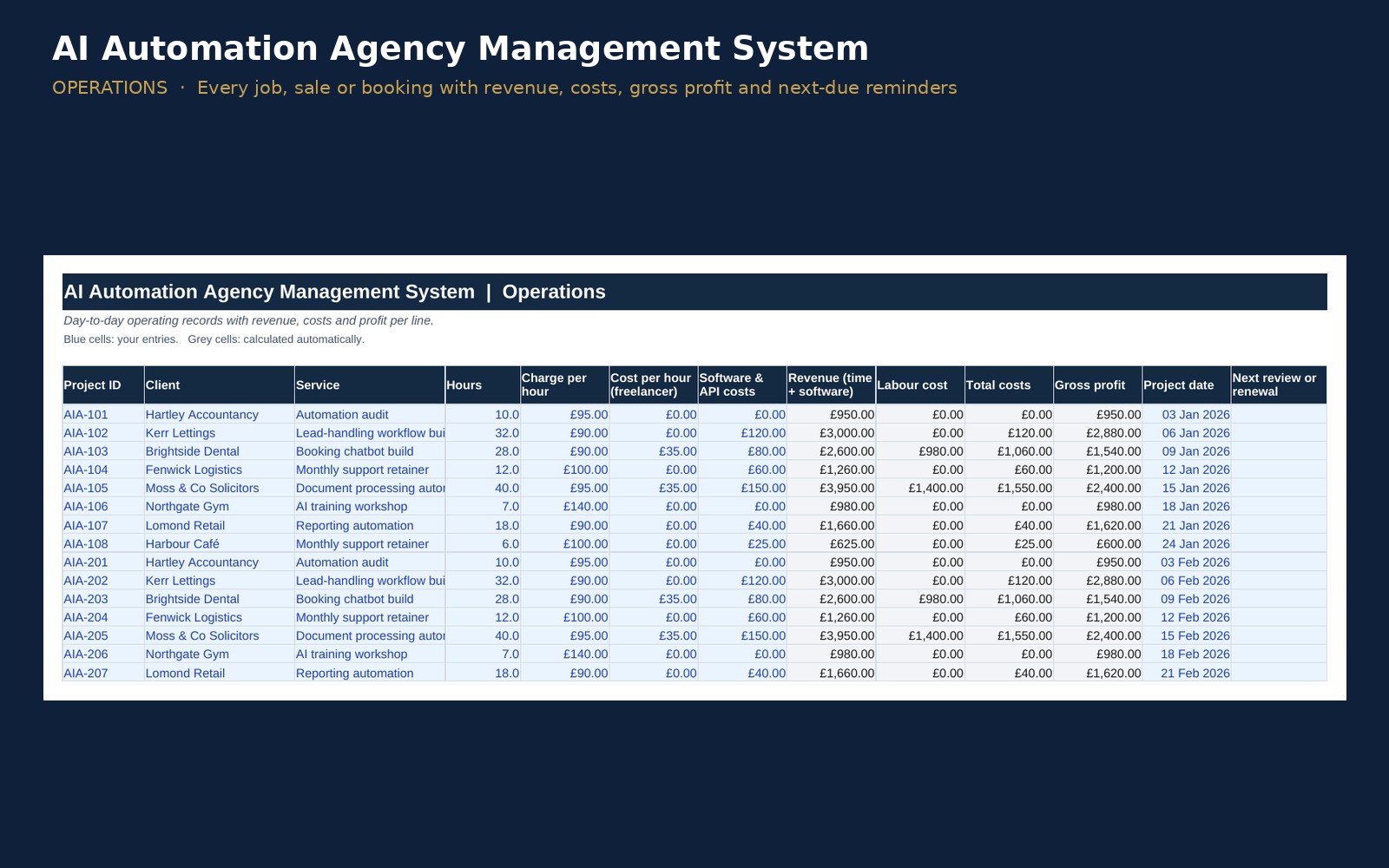
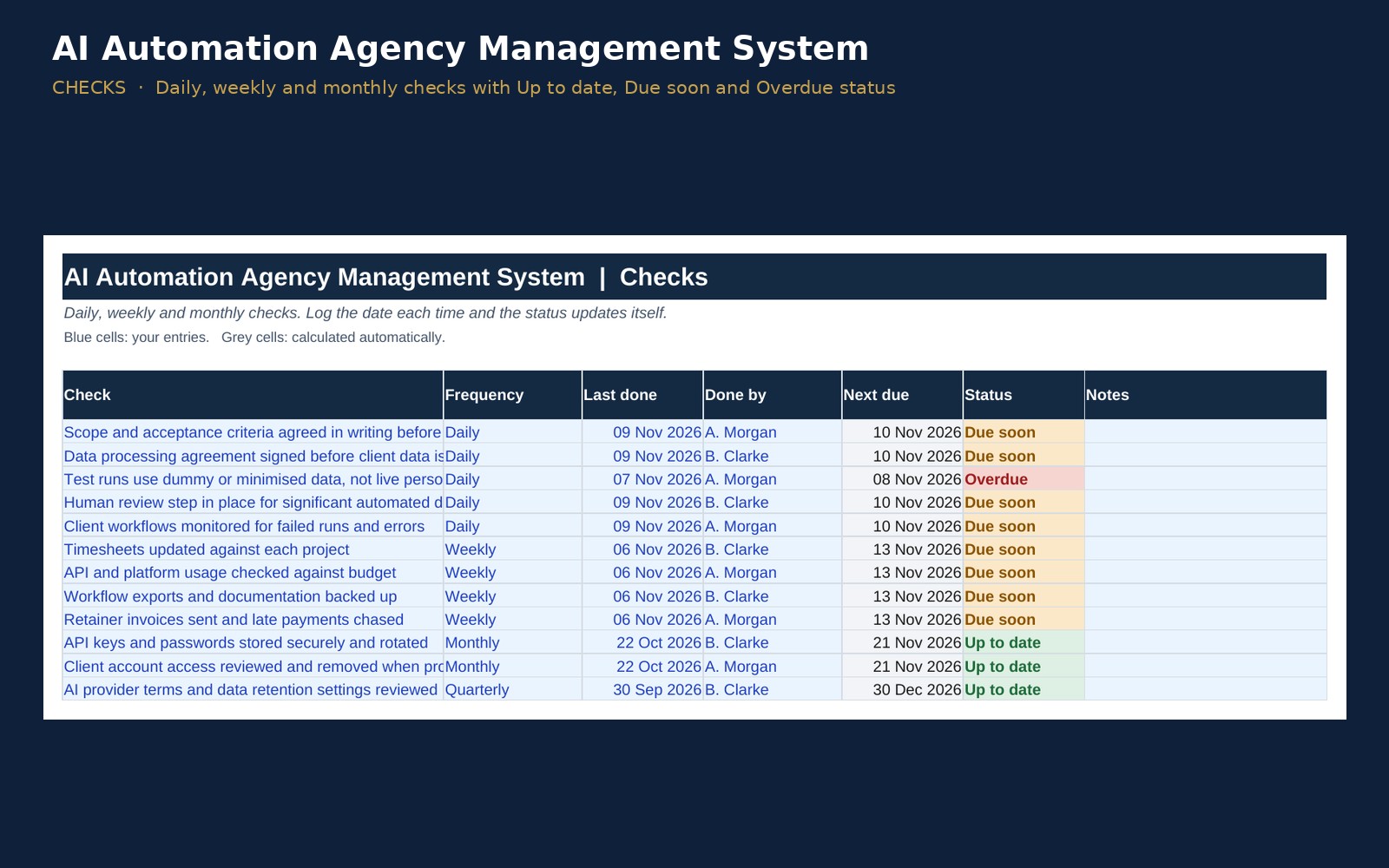
The **AI automation agency spreadsheet** runs the business side in one Excel file for £15, with no subscription: - Projects and retainers by client, with hours, rates, freelancer costs and software/API costs on every line - Gross profit per project, invoices, debtors and "chase these first" - A 12-week cash flow forecast and VAT summary - Daily checks: written scope, data processing agreement, dummy test data, human review, workflow monitoring - Weekly and monthly checks: timesheets, API usage against budget, backups, invoices, key rotation, access removal - A compliance register: ICO fee, PI and cyber insurance, data processing agreement template, terms, privacy notice, Cyber Essentials - Risk assessments: data breach, AI errors, special category data, platform outages, scope creep - A dashboard with average project value, billable hours, software costs billed and labour margin
Your AI automation agency start-up checklist
1. Pick one niche and one painful process. 2. Work out your start-up costs and minimum day rate with the free AI workflow automation calculator. 3. Register your business and pay the ICO data protection fee. 4. Write a data processing agreement template. 5. Write terms of business that cover scope, IP and liability. 6. Get professional indemnity and cyber insurance. 7. Build one case study, even for a discounted first client. 8. Package your services: audit, build and retainer. 9. Add human review to any significant automated decision, and keep special category data out of solely automated ones. 10. Track hours, software costs and margin on every project. 11. Write a plan with the AI automation agency business plan template.
Want everything at once? The AI Automation Agency Full Business Pack includes the management system, the business plan template and all the free guides for £20.
Frequently asked questions
Do I need qualifications to start an AI automation agency in the UK? No licence or formal qualification is required. Clients will judge you on results, case studies and how you handle their data.
Do I need to register with the ICO? Most businesses that process personal data must pay the ICO data protection fee. An automation agency handling client customer data almost always does.
Can I automate decisions about people? Since 5 February 2026, more lawful bases are available for automated decision-making, but safeguards are still required, and special category data still can't be used in solely automated significant decisions.
What should I charge as a new AI automation consultant? Start from your minimum viable day rate. In our worked example, that's about £443 a day at 115 billable days, then package your work into audits, builds and retainers.
What's the biggest risk for a new agency? Underpricing fixed-price builds, then absorbing scope creep and platform costs. Written scope, staged payments and pass-through pricing protect you.
Should I set up as a sole trader or a limited company? Many consultants start as sole traders because it's simple and free to register. A limited company may suit you once profits grow or larger clients prefer it. Companies House charges £100 for digital incorporation or £124 for paper filing; same-day digital incorporation through software costs £156 (fees from 1 February 2026). Check the current Companies House fees before filing. Get accounting advice for your situation.
*Sources: Companies House fees (checked 15 November 2026); ICO guidance on the Data (Use and Access) Act 2025 (updated 19 June 2026); A&O Shearman, CMS and Trowers & Hamlins commentary on the 2026 commencement; James Edison AI workflow automation calculator (UK 2026 market ranges); industry pricing estimates for 2024 to 2026. This guide is general information, not legal advice.*