Candles are one of the most-searched creative business ideas in the UK, according to 1st Formations' study of Google searches. They're cheap to start, but the law treats every home candle maker as a producer, and most new brands get the labels wrong.
This guide covers the business side: your safety duties, what must be on the label, burn testing, pricing for profit, what it costs to start and how many candles you need to sell to break even.
1. Choose your range and customer
Start with a small, tested range rather than dozens of scents. Decide who you're selling to, such as gift buyers, home decor fans or local shops, because that decides your jar, price and packaging.
2. Know your duties as a producer
Making candles to sell, even from your kitchen, makes you a producer under the General Product Safety Regulations 2005. You must assess each product's safety before selling it, keep records, and be able to trace every candle by batch (Business Companion).
3. Get the CLP label right
Many fragrance oils contain sensitisers. At 0.1% or more, the label generally needs "Contains [substance]. May produce an allergic reaction." Above about 1%, the whole candle is classified and needs a pictogram, hazard statements and precautionary statements. Labels must be firmly fixed and easy to read. You also need the nominal quantity (grams for candles, millilitres for diffusers) and a batch number. Your fragrance supplier's safety data sheet tells you what applies.
4. What it costs to start
Our free calculator's planning figures:
| Item | Lean | Base | High |
|---|---|---|---|
| Starter wax, wicks, jars and fragrance | £100 | £400 | £1,500 |
| Equipment | £50 | £300 | £1,500 |
| Burn testing and safety assessment | £0 | £150 | £600 |
| CLP and safety labels | £30 | £150 | £400 |
| Packaging and branding | £50 | £400 | £1,500 |
| Insurance (year 1) | £60 | £150 | £400 |
| Online store and product photos | £0 | £300 | £1,500 |
| Craft fair pitches and launch marketing | £0 | £400 | £1,500 |
| Working capital reserve | £200 | £1,000 | £3,000 |
| Total | £490 | £3,250 | £11,900 |
Work through your own figures with the free candle business startup calculator.
5. Burn-test and add safety warnings
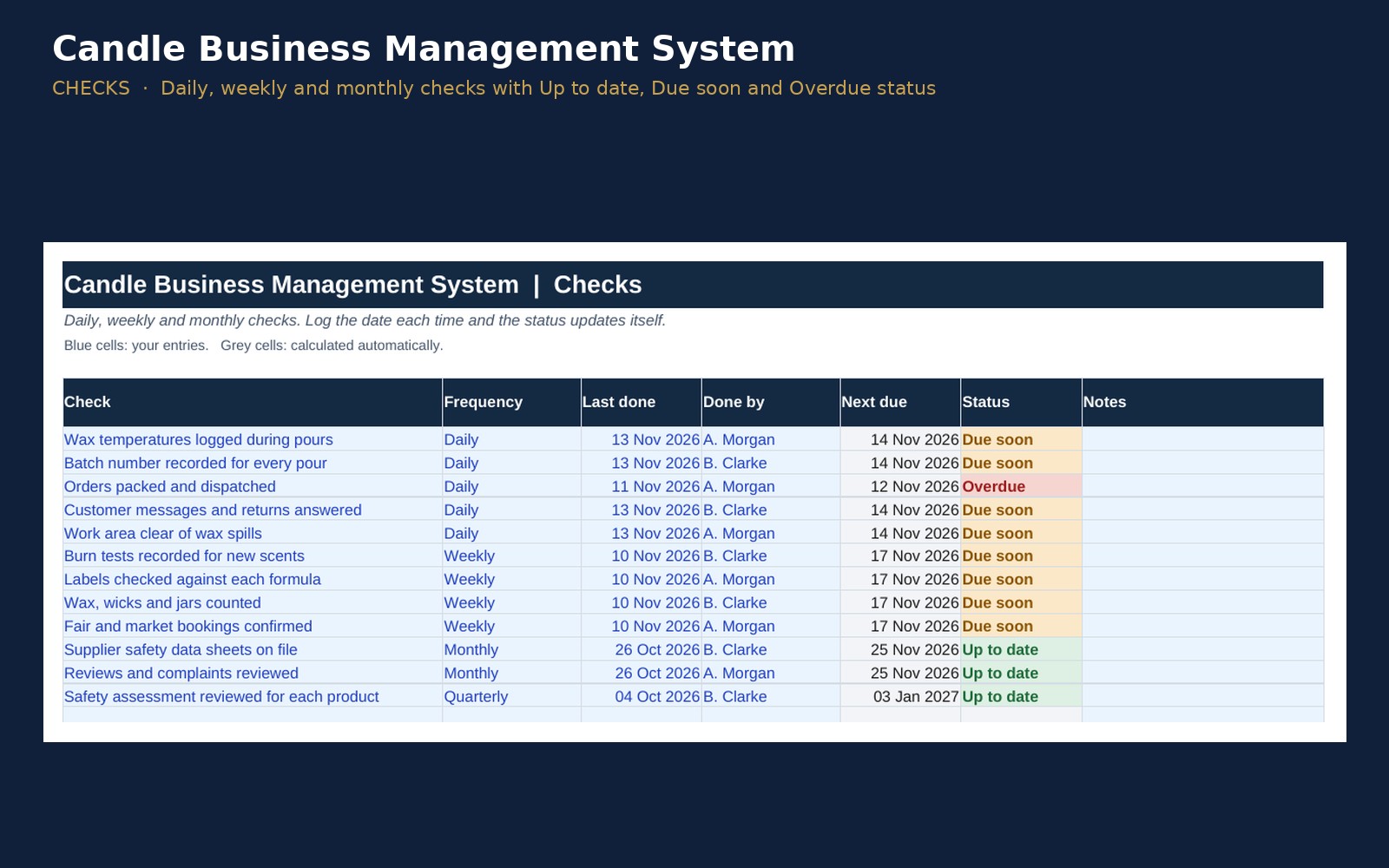
Test every combination of wax, wick, jar and fragrance. The designated standards are BS EN 15493 (fire safety), BS EN 15426 (sooting) and BS EN 15494 (safety labels). Meeting them supports a due diligence defence. Candles that could be mistaken for food are banned.
6. Insurance and selling online
Get product liability cover, plus public liability for craft fairs and workshops. If you sell online, show your business details and remember customers usually have a 14-day right to cancel.
7. Price for profit
Work out your full cost per candle: wax, wick, jar, fragrance, labels, packaging and a share of postage, fees and pitch costs. Set a retail price that leaves a healthy margin, and a separate wholesale price for shops. Our calculator's example uses an average selling price of £17 and a cost of £4.50 per candle.
8. Work out your break-even
With £200 of monthly fixed costs and an £800 owner-pay target, that example needs about 80 candles a month to break even, roughly 19 a week. Christmas will be far busier than summer, so plan your stock and cash around the season.
9. Where to sell
- Your own online store: the best margin, and you own the customer list
- Craft fairs and markets: feedback, sales and a following
- Wholesale to gift shops: bigger orders at a lower price
- Workshops: candle-making sessions for groups and parties
- Corporate gifts: branded candles for local businesses
10. Run it like a business
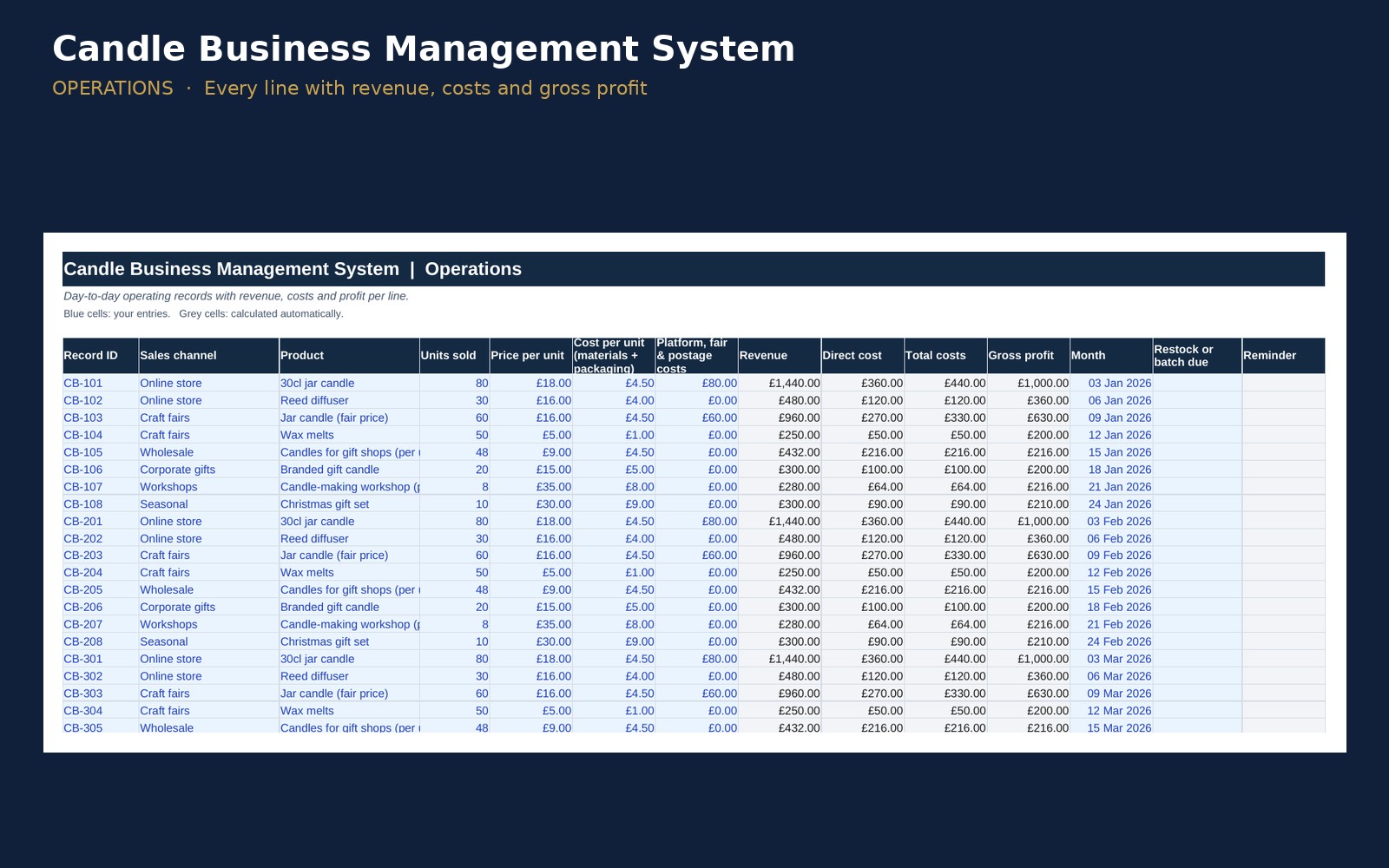
Track units sold, cost per candle, gross margin, sell-through by scent and takings per fair every month. Keep your safety assessments, burn tests, safety data sheets and labels together, and review them whenever you change a supplier or recipe.
Your candle business start-up checklist
- [ ] Range and customer chosen
- [ ] Safety assessment for each product
- [ ] Burn tests recorded
- [ ] Supplier safety data sheets
- [ ] CLP labels and allergen statements
- [ ] Safety warnings (BS EN 15494)
- [ ] Batch numbers
- [ ] Insurance in place
- [ ] Break-even candles known
- [ ] Retail and wholesale prices set
Run it properly from day one
The **Candle Business Management System** is a candle business spreadsheet that tracks every order, cost, invoice and VAT return, with checks, compliance dates, risks and stock in one Excel file. It costs £15 once, with no subscription. Planning to borrow? The Candle Business Plan Template (£10) is laid out the way lenders expect, or get both with every free guide in the Full Business Pack for £20.
Next, read how much a candle maker earns and the KPIs to track.
Related: Online shop startup costs
Frequently asked questions
How much does it cost to start a candle business in the UK? A small kitchen-table start can be about £500. Our calculator's base launch, with stock, testing, labels, packaging, insurance and a store, is around £3,300.
Do candles need CLP labels? Often, yes. If your fragrance contains a sensitiser at 0.1% or more, the label usually needs an allergen statement, and above about 1% the candle is classified and needs a pictogram and hazard statements. Unscented, unclassified candles often need no CLP label.
Do I need a licence to sell candles? There's no licence, but you must make safe products, label them correctly and keep records under product safety law.
Can I sell candles from home? Yes. Many candle businesses start at home. Check your home insurance covers making and storing stock, and keep the work area safe from fire.
Is a candle business profitable? It can be, if your price covers every cost per candle and leaves enough after fixed costs. Use our calculator to find your break-even.