Yoga and Pilates have never been more popular in the UK, and reformer Pilates studios are opening on high streets everywhere. Health and wellness also tops the list of sectors Brits say they'd most like to start a business in, according to a September 2026 Uswitch survey.
The popularity hides a hard truth that most "how to become a yoga teacher" guides skip: teaching classes for other people rarely pays a living. This guide covers the business side: the real income figures, the music licence most new teachers miss, hall hire against your own studio, start-up costs, and how many paid class visits you need to break even.
1. Start with the real income figures
Insure4Sport's 2026 survey of UK yoga and Pilates teachers found: - An average annual income from teaching of £5,238 for yoga teachers and £11,238 for Pilates teachers, an average of £8,750 across all respondents. - 46% of teachers earned under £2,500 a year from teaching. - Only 10% earned £30,000 or more. - Travel costs were the most common rising expense (49% of teachers), with venue hire and insurance close behind (around a third each).
Studio class fees for freelance teachers are typically a flat fee per class or a revenue share. Even a newly qualified teacher on a busy timetable at a community studio might gross £7,000 to £16,000 a year from classes.
The lesson: the money is in owning the business. That means running your own classes, private sessions, workshops and eventually your own studio, not just teaching other people's timetables. The rest of this guide is about doing that profitably.
2. Get qualified and insured
There's no legal licence to teach yoga or Pilates in the UK, but studios and insurers expect a recognised qualification:
- 200-hour yoga teacher training accredited by a yoga body (such as Yoga Alliance or Yoga Alliance Professionals). These typically cost £2,500 to £4,500.
- Ofqual-regulated Level 3 or Level 4 diplomas, including British Wheel of Yoga routes. Some Level 3 courses cost under £1,000.
- Pilates has its own matwork and reformer qualifications. Reformer teaching needs specific equipment training.
Before you teach, get teacher insurance and public liability cover, plus studio insurance if you have premises, and a first aid certificate.
3. The music licence most teachers miss
PPL PRS, the UK's music licensing body, classes yoga and Pilates as fitness classes for music licensing. If you play recorded music, you need a licence:
- Independent instructors running classes outside a fitness centre (in village halls or community centres, for example) need their own licence. PPL PRS's February 2026 example puts 3 classes a week, 50 weeks a year, in a village hall at about £345 a year.
- Studio and fitness centre operators are liable for all classes on their premises, including classes run by freelance teachers.
- Streaming classes online can need extra licensing.
Budget for it, log your classes, and check your venue's licence if you hire a space.
4. Hall hire or your own studio?
| Model | Costs | Benefits | Risks |
|---|---|---|---|
| Hired halls | Hourly hire, music licence, insurance | Low risk; test demand cheaply | Limited times, carrying kit, no space to grow |
| Your own studio | Lease, fit-out, rates, utilities, insurance | Full timetable, workshops, retail, reformers | Fixed costs every month, whether classes fill or not |
| Reformer studio | All of the above plus machines | High prices and strong demand | Expensive equipment, servicing, specialist teachers |
Many successful studio owners start in halls, build a loyal following and full classes, then open a studio with a waiting list of students.
5. What it costs to start
Our free start-up calculator uses three scenarios. These are planning figures, not quotes:
| Item | Lean (halls) | Base (small studio) | High (reformer studio) |
|---|---|---|---|
| Teacher training | £0 | £2,500 | £4,500 |
| Insurance (year 1) | £60 | £150 | £400 |
| Music licence (year 1) | £0 | £345 | £900 |
| Studio deposit and fit-out | £0 | £3,000 | £25,000 |
| Mats, props and sound system | £100 | £1,200 | £3,000 |
| Reformer machines | £0 | £0 | £24,000 |
| Booking software and website | £0 | £300 | £900 |
| Launch marketing | £0 | £500 | £2,000 |
| Working capital reserve | £500 | £4,000 | £12,000 |
| Total | £660 | £11,995 | £72,700 |
The lean column assumes you're already qualified and teaching in hired halls. For reformer machines, get supplier quotes: the figure here is only a placeholder.
6. Work out your break-even class visits
In the calculator's base studio example: - £14 average revenue per visit, across drop-ins, class passes and memberships - £3.50 per visit for teacher pay share, cleaning and booking fees - £2,400 a month of fixed costs (rent, utilities, insurance, music licence, software) - £1,800 a month owner-pay target
Each visit contributes £10.50. Fixed costs plus pay are £4,200. £4,200 ÷ £10.50 = 400 paid class visits a month to break even. That's about 100 a week: for example, 10 classes a week averaging 10 students.
At 600 visits a month, this studio has about £2,100 a month above its target. At 300, it's losing money. Class fill rate is everything.
7. Price for a full timetable
- Intro offer: a low-cost first week or month to get people through the door. Track how many convert to passes or memberships.
- Class passes: paid upfront, so they're good for cash flow. Set expiry dates.
- Memberships: recurring income that smooths quiet months. Price them so regular students save money compared with passes.
- Reformer, privates and workshops: higher prices for smaller groups and specialist sessions.
- Review your timetable monthly. Cut or move classes that don't fill, because a half-empty class still costs rent and a teacher.
Memberships and the 2027 rules: if you sell auto-renewing memberships to consumers, the UK subscription rules starting on 1 January 2027 require reminder notices, easy online cancellation and cooling-off rights. Build them into your booking system now.
8. Fill your classes
A studio lives or dies on fill rate. What works:
- Start with a following. Students follow teachers, not buildings. Build a loyal group in halls before you open a studio.
- Make the first class easy. Clear directions, a friendly welcome, mats and props provided, and a follow-up message afterwards. First-class experience decides whether intro offers convert.
- Specialise. Beginners, pregnancy and postnatal, men's yoga, over-60s, back care and athletes all fill more reliably than "all levels" classes competing with every gym.
- Get local visibility. A Google Business Profile with photos, a class timetable and reviews, plus listings on booking apps your audience already uses.
- Partner up. Physios, sports clubs, running groups and local businesses (for workplace classes) send steady referrals.
- Run workshops and courses. A 4-week beginners' course fills better than an open-ended class and converts naturally into passes.
Track where each new student came from and which intro offers convert, so you spend money where it works.
9. Keep students safe
- Health questionnaire for every new student, and options for every level in every class.
- Hands-on adjustments only with consent.
- Hot classes: control the temperature, make sure water is available, and tell students to rest when they need to.
- Reformers: inspect springs, straps and ropes weekly, and have machines serviced every year.
- Fire risk assessment, especially if you use candles or heaters.
- Health data: questionnaire answers are special category data under UK GDPR. Store them securely and pay the ICO data protection fee.
10. Common mistakes new studio owners make
1. Opening a studio before the classes are full. Fixed costs start on day one, whether or not students come. 2. Too many classes on the timetable. More classes with fewer students each raises costs without raising income. 3. Forgetting the music licence. It applies to yoga and Pilates, and studios are responsible for freelance teachers' classes too. 4. Pricing passes too cheaply. Regular students on cheap passes can bring your average revenue per visit below break-even. 5. Not tracking teacher cost per class. Paying a flat fee for a class with three students loses money. 6. No plan for reformer servicing. Equipment that breaks mid-class is a safety risk and a refund.
11. Run it like a business
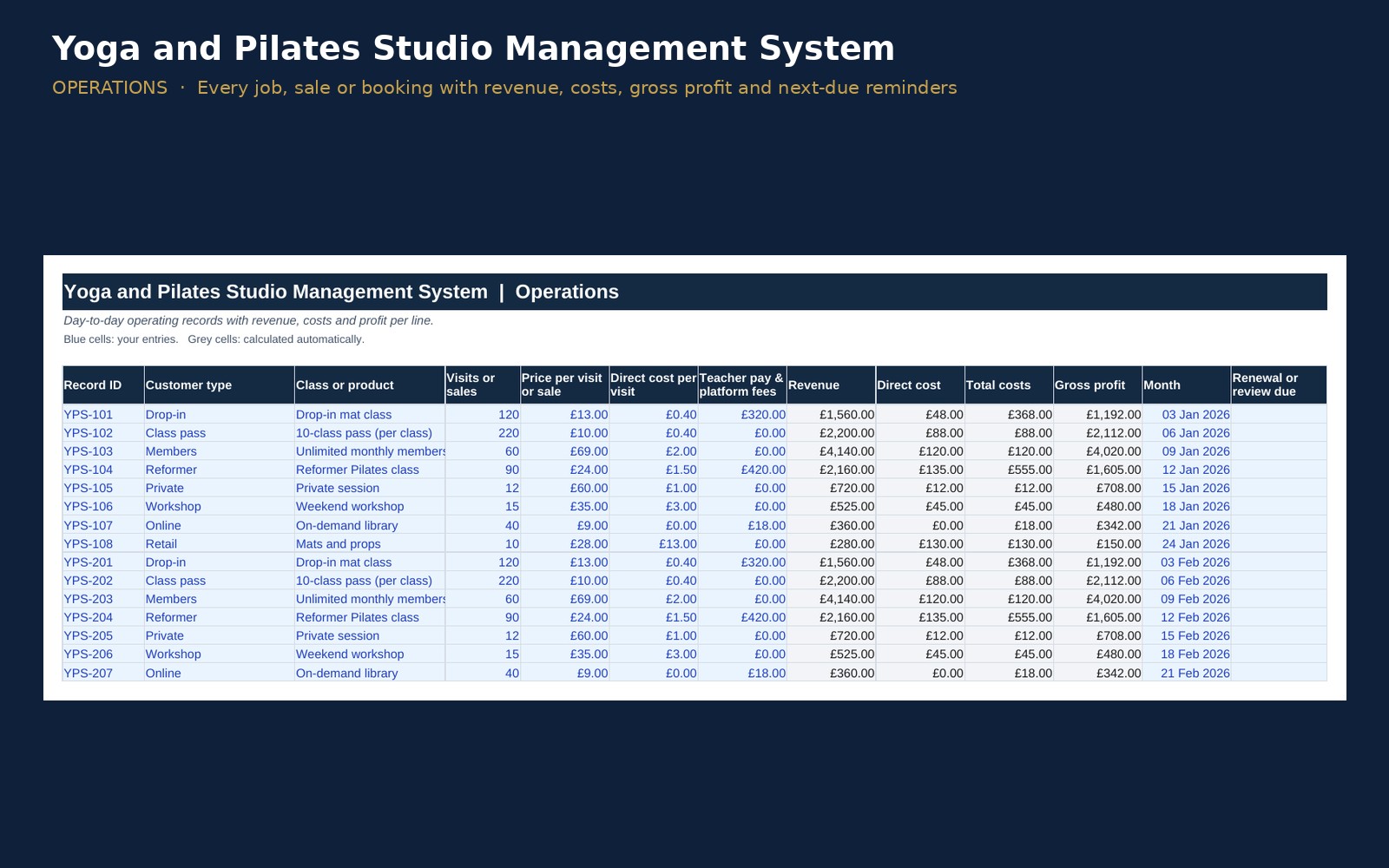
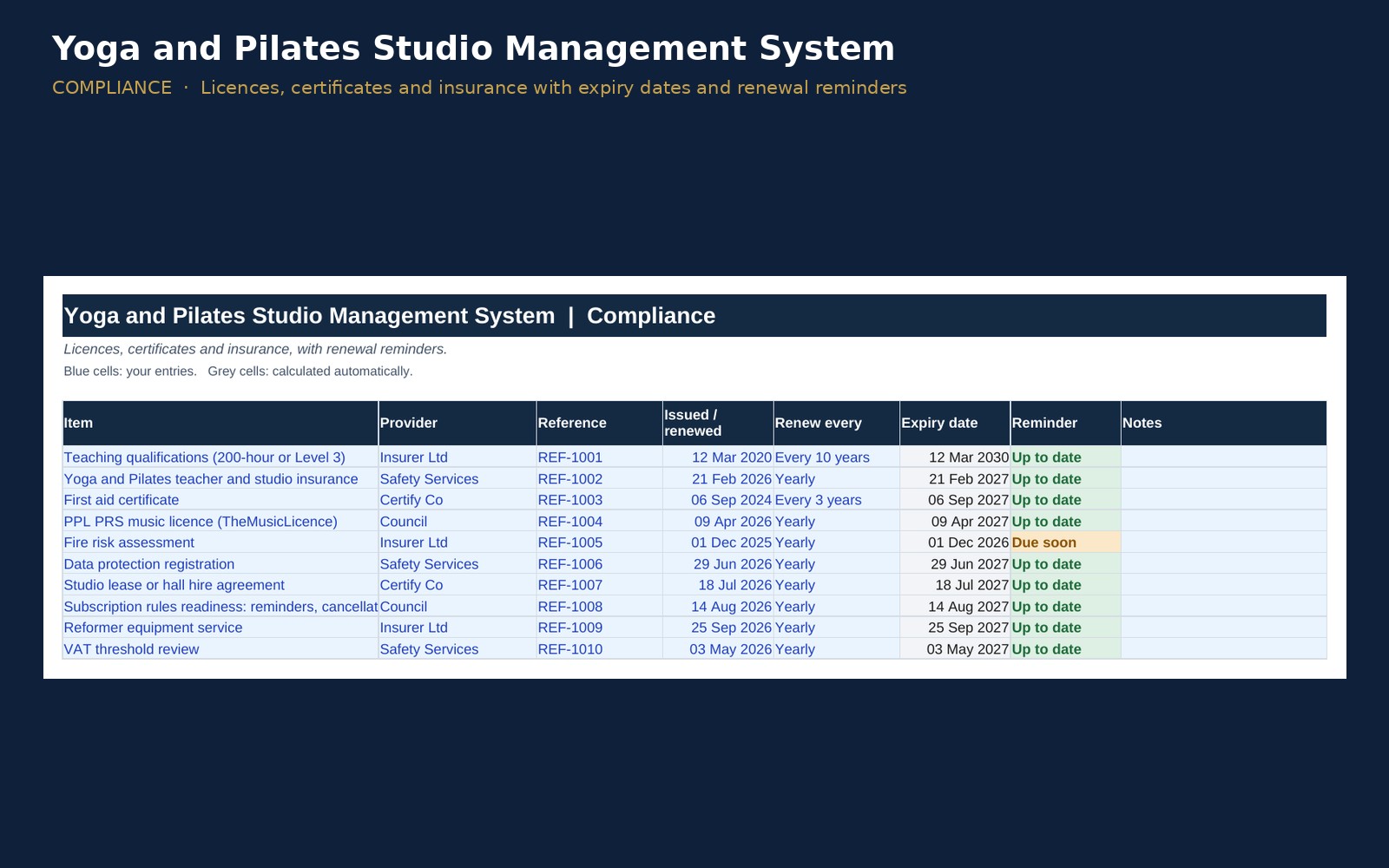
The **yoga studio management spreadsheet** runs the business side in one Excel file for £15, with no subscription: - Visits and sales by type: drop-ins, class passes, memberships, reformer, privates, workshops, online and retail - Price, direct costs, teacher pay and platform fees, with gross profit on every line - Invoices, debtors, a 12-week cash flow forecast and VAT summary - Daily checks: health questionnaires, cleaning mats and reformers, studio temperature, bookings and waitlists - Weekly checks: reformer springs and straps, first aid kit, fire exits - Monthly checks: teacher insurance, music licence log, membership renewal reminders, timetable review - A compliance register: qualifications, insurance, PPL PRS licence, fire risk assessment, ICO fee, lease, subscription rules, reformer service - Risk assessments: strain, reformer injury, slips, overheating, fire and health data - Stock: mats, blocks, straps, bolsters, blankets, reformer springs and retail
Planning bigger? The Fitness Studio & Gym Membership Model forecasts membership growth, churn and profit for a larger studio.
Your studio start-up checklist
1. Get qualified and insured. 2. Sort your music licence, as an instructor or as a studio. 3. Start in halls and build a following before signing a lease. 4. Work out your costs and break-even visits with the free yoga and Pilates studio start-up calculator. 5. Set prices for intro offers, passes and memberships. 6. Build January 2027 subscription rules into your memberships. 7. Complete a fire risk assessment and set up safety checks. 8. Set up health questionnaires and secure records, and pay the ICO fee. 9. Write a plan with the yoga and Pilates studio business plan template.
Want everything at once? The Yoga and Pilates Studio Full Business Pack includes the management system, the business plan template and all the free guides for £20.
Frequently asked questions
Do I need a licence to teach yoga or Pilates in the UK? No legal licence is required, but studios and insurers expect a recognised qualification such as a 200-hour course or a Level 3 diploma.
Do I need a music licence for yoga classes? Yes, if you play recorded music. PPL PRS classes yoga and Pilates as fitness classes. An instructor running 3 classes a week in a village hall pays about £345 a year, and studios are liable for all classes on their premises.
How much do yoga teachers earn in the UK? Insure4Sport's 2026 survey found an average teaching income of £5,238 for yoga teachers and £11,238 for Pilates teachers. Many teach part-time alongside other work.
How many students does a studio need to break even? In our worked example, about 400 paid visits a month (roughly 100 a week) covers £2,400 of fixed costs and £1,800 of owner pay.
Should I start with reformer Pilates? Only with strong local demand and a plan for the equipment cost, servicing and specialist teachers. Many owners start with mat classes and add reformers later.
Can I teach yoga online? Yes. Many teachers add live-streamed or on-demand classes. Check your music licensing for online use, and make sure your insurance covers online teaching.
*Sources: Insure4Sport Yoga & Pilates Teacher Survey UK 2026; PPL PRS cost examples (February 2026) and fitness tariff; ukactive licensing guidance; salarytax.uk; Uswitch September 2026; Legal 500 on the January 2027 subscription rules. This guide is general information, not legal or financial advice.*